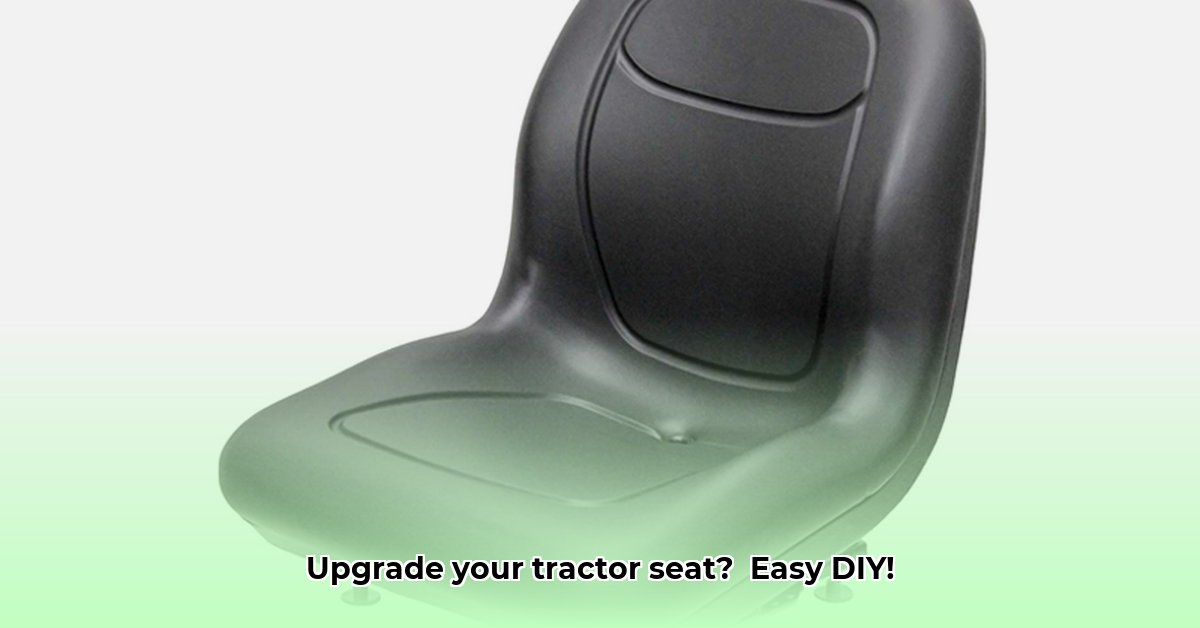
Is your New Holland tractor seat causing you discomfort or hindering your productivity? A comfortable and well-functioning seat is crucial for long days in the field. This comprehensive guide will walk you through replacing your tractor seat—a DIY project that can save you both time and money. For more detailed instructions, check out this helpful repair guide. We'll cover everything from identifying your current seat model to enjoying your newly installed, comfortable ride!
Identifying Your Tractor's Seat Model
Before ordering a replacement, you need to determine your tractor's seat model number. This is essential for finding a perfectly compatible replacement. Check under the seat or on the seat's frame for a label, sticker, or metal plate displaying the model number. Take a clear photo of this identifying information; it's invaluable when ordering a replacement seat.
Choosing the Right Replacement Seat
Selecting your new seat involves several key decisions. Let's examine your options:
Direct Fit Kits vs. Individual Components
Two main approaches exist: purchasing a complete, pre-assembled kit or sourcing individual components.
| Feature | Pre-Assembled Kit | Individual Components |
|---|---|---|
| Convenience | High – ready to install | Lower – requires assembly and more research |
| Cost | Generally higher upfront | Potentially lower, depends on part selection |
| Installation | Simpler, faster | More involved, requires mechanical knowledge |
| Compatibility Risk | Lower – less chance of parts mismatch | Higher – potential compatibility issues |
Consider your mechanical skills and budget when making your choice. A direct-fit kit offers convenience, while sourcing individual components could offer cost savings.
Suspension Types: Air vs. Mechanical
Tractor seats utilize either air or mechanical suspension. Air suspension systems provide a superior, smoother ride, especially over rough terrain. However, they are generally more expensive. Mechanical suspension is simpler, more affordable, and robust, but offers less cushioning. Your choice depends on your priorities and typical working conditions. What type of terrain do you typically work on? A smoother ride might be worth the extra investment.
Manufacturer Options
Several reputable manufacturers produce high-quality seats for various tractor models. Grammer, Pilot, and Sears Seating are prominent examples. While brand matters less than compatibility and features, researching manufacturer reputations is wise. Do your research and check out customer reviews to ensure a well-made seat.
Tools and Materials
Gather the necessary tools before beginning the installation process. This will ensure a smooth and efficient workflow. You'll need:
- Socket set (various sizes)
- Wrench set (various sizes)
- Screwdrivers (Phillips and flathead)
- Torque wrench (essential for proper tightening)
- Safety glasses (protect your eyes!)
- Work gloves (for safety and cleanliness)
Step-by-Step Installation Guide
This detailed guide offers a general procedure; modifications may be needed depending on your specific seat and tractor model. Always consult your new seat's instructions and your tractor's owner's manual for any specific instructions.
Step 1: Disconnection. Carefully disconnect any electrical connectors, hydraulic lines, or other attachments connected to your old seat. Take photos as you progress for reference during reassembly.
Step 2: Removal. Carefully remove the bolts securing the old seat to the tractor. Two hands are often helpful for heavier seats.
Step 3: Preparation. Clean the mounting area thoroughly to ensure a smooth and secure installation of the new seat.
Step 4: Installation. Gently position the new seat, ensuring correct alignment with the mounting brackets. Secure it using the appropriate bolts, tightening them to the manufacturer's specified torque using your torque wrench. This is essential for safety.
Step 5: Reconnection. Reattach all previously disconnected components, using your photos from Step 1 as a guide.
Step 6: Testing. Reconnect the battery and thoroughly test the new seat, checking for loose components, function, and any unusual noises.
Troubleshooting and Safety
Should you encounter difficulties, consult your new seat’s instructions and your tractor's owner’s manual. For persistent issues, seek professional assistance. Always prioritize safety. Before working on any electrical parts, disconnect the tractor battery. Never work underneath a raised seat without proper support.
Maintenance and Warranty
Regularly inspect your new seat for wear and tear. Keep it clean and lubricate moving parts as needed to extend its lifespan. Review your warranty information thoroughly to understand the terms and conditions.
Conclusion
Replacing your New Holland tractor seat is a manageable DIY project that enhances both comfort and productivity. With a carefully planned approach, the right tools, and a bit of patience, you can significantly improve your driving experience. Enjoy your newly comfortable and efficient ride!